
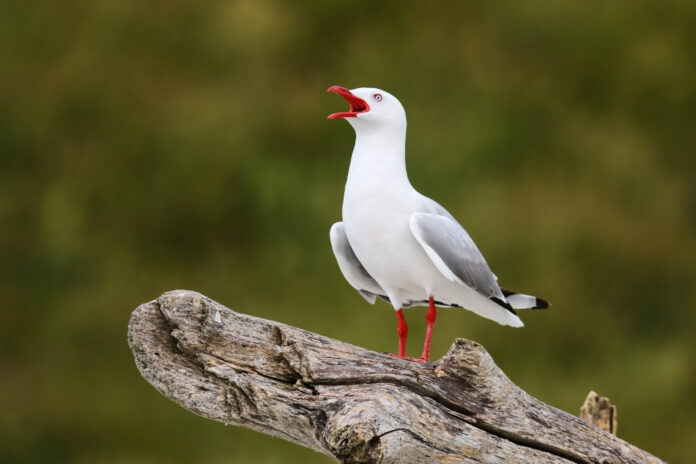
Clutha District Council has expressed its sadness at the senseless deaths of five protected native red-billed gulls/tarāpunga at Cannibal Bay in the Catlins last weekend.
In a statement, the Council urged people driving on beaches to take care around vulnerable wildlife and other beach users.
“Our Vehicles on Beaches bylaw requires drivers to act responsibly and show due consideration for people and wildlife,” said Community Services Group Manager, Mike Goldsmith.
“The deaths of these birds are extremely disappointing and were entirely preventable.”
The incident was reported by a Clutha District Council ranger who discovered the dead birds while on a regular patrol last Saturday.
The gulls appeared to have been deliberately run over or struck while trying to evade a four-wheel drive vehicle or vehicles on the beach. The entire beach was covered in vehicle tracks, which also included those of dirt bikes, the ranger reported.
DOC Principal Biodiversity Ranger, Sean Jacques says it was shocking that the driver or drivers appear to have deliberately targeted the gulls at five separate locations on the beach.
“Red-billed gulls/tarāpunga are a protected native species and we view the harming of them very seriously,” he said.
“It’s extremely disappointing that people would target vulnerable native wildlife in this way.
“We’re appealing for witnesses or anyone who has information about the vehicles driven on Cannibal Bay beach just prior to Saturday to contact us on 0800 DOCHOT.”
Mr Jacques said that while red-billed gulls are a familiar species in coastal areas, their population is declining and their conservation status is ‘At Risk – Declining’.
Mr Goldsmith said Council bylaws were in place specifically to protect people and wildlife from reckless vehicle use on beaches.
The bylaw, in part, requires anyone operating a vehicle to show due consideration to other beach users and vulnerable wildlife, and to drive in a courteous, safe and responsible manner.
“We want people to enjoy our beaches while also respecting the wildlife that depend on them,” he said.
“The deaths of these birds are extremely disappointing and were entirely preventable. Beaches are shared spaces, and drivers have a responsibility to take care around vulnerable wildlife and other beach users.
“We urge anyone with information which could help identify those responsible to come forward.”
Cannibal Bay is an important haul-out and social gathering site for sea lions and DOC has been working with local community groups and schools in the area to raise awareness about pakake and how to safely share the environment with them.
It is an offence under the Wildlife Act to harass, hunt or kill protected species. Offenders can be sentenced up to two years imprisonment and issued a fine of up to $250,000.
The public can report wildlife harm incidents to DOC on 0800 DOC HOT (0800 362 468) or wildlifecrime@doc.govt.nz.
If you have information that could help identify those responsible, please contact the Department of Conservation by calling 0800 DOCHOT.
