

Palmerston North City Council is inviting local residents, businesses and the wider community to have their say on the next stage of the Manawatū Regional Freight Ring Road business case.
Following the first round of community engagement in December last year, the Council has developed 26 long-list options into a shortlist of 12 whole-route options. Those 12 routes have since been put through more detailed technical assessments and transport modelling, which has identified an emerging technical preferred option based on the evidence so far.
“We’ll be returning in October to venues in Ashhurst, Bunnythorpe, Longburn and Linton with a series of community expos to show what has changed, explain what we’ve learned from the assessments and get feedback on the shortlisted routes before a preferred route is confirmed,” the Council said in a statement.
The ring road aims to improve how heavy vehicles move around the outskirts of Palmerston North. It would help reduce congestion and road deterioration in the city, and improve safety for walking and cycling, by keeping more heavy vehicles off residential streets, while strengthening connections between key industrial areas, freight hubs, and state highways, Council stated.
The project is currently in the later stages of the Indicative Business Case, which is an early planning phase to identify the preferred route. A preferred route has not yet been confirmed, and more detailed design, consenting, funding and approvals would still be required before construction could begin. The business case will provide NZ Transport Agency Waka Kotahi with the evidence required to unlock potential Government funding.
“More than 640 people got involved in the long-list engagement. We’ve used that feedback, alongside technical assessments, to refine the options into 12 complete routes,” said Council’s Strategic Planning General Manager, David Murphy.
“There were more than 100 possible combinations, so the 12 shortlisted routes were developed to test the key differences and help us understand which parts perform well and where the trade-offs are.
“This next round of engagement is about showing our community that evidence trail — what you told us, what progressed and why, what the shortlist testing is telling us so far — and then asking what you think before we confirm a preferred route.”
The shortlist includes a range of approaches, from targeted improvements to existing roads and intersections through to new bypasses and different locations for a new bridge over the Manawatū River.
The emerging technical preferred option brings together parts of different routes that have performed well through preliminary technical assessments. This is not the preferred route, but it shows everyone where the technical evidence is currently pointing based on the assessments completed so far, said Mr Murphy.
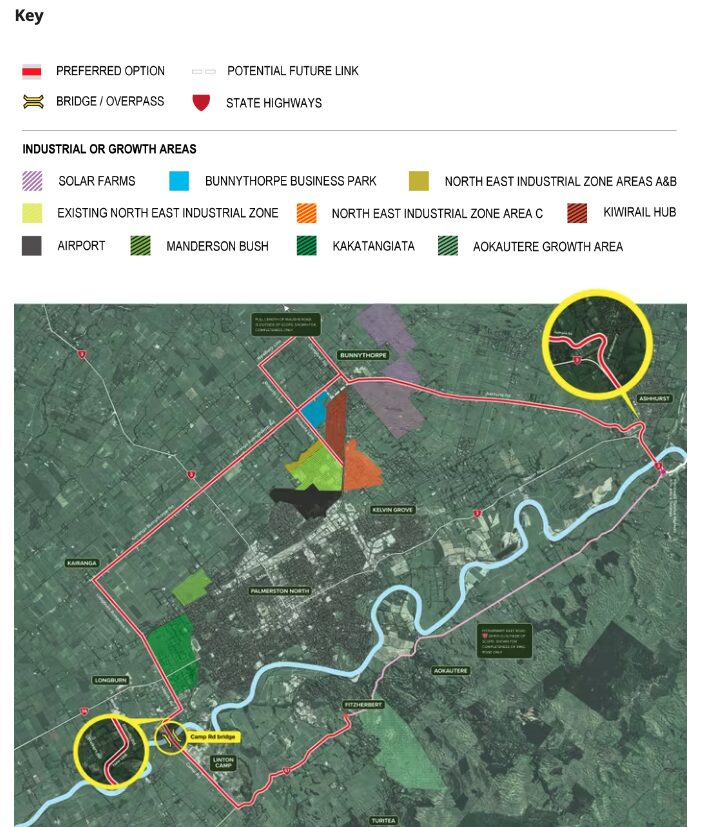
He says it’s important that the public doesn’t view the emerging technical preferred option as a decision that has already been made.
“We’re deliberately showing people where the technical work is pointing so far, rather than waiting until the end of the business case process, because we want to be transparent with our community.”
“But this is not the preferred route. We still need community feedback and further technical work before we bring all of that evidence together and land on a preferred option. Feedback on the shortlisted options will focus on what people think works well, what concerns them, what parts of the proposed routes they would change, which improvements should be prioritised if the project is delivered in stages, and any important local knowledge that the assessment may have missed.”
Mayor, Grant Smith says progressing to the shortlist is an important milestone for a project that has been planned by Council for more than two decades and could support Palmerston North and the wider region for generations.
“A project of this scale needs strong evidence to help us identify and test the preferred route, and community knowledge is part of that,” he said.
“We had a great response last year, and I’d encourage anyone who participated to come back, see how their feedback has shaped the work and have another say before we settle on a preferred route. We had hoped to finish the business case before the general election, but we’re focused on getting it right, and that means further engagement with our community.
“I remain committed to continuing to advocate for the regional freight ring road to all political parties. We encourage anyone in the community, and transport, logistics, and business sectors, to do so too.”
The regional freight ring road is a partnership with NZ Transport Agency Waka Kotahi, Horizons Regional Council, and the Manawatū District Council. It is part of the Palmerston North Integrated Transport Initiative, commissioned by NZTA.
Feedback opens on Monday 12 October and will close on Friday 30 October.
