
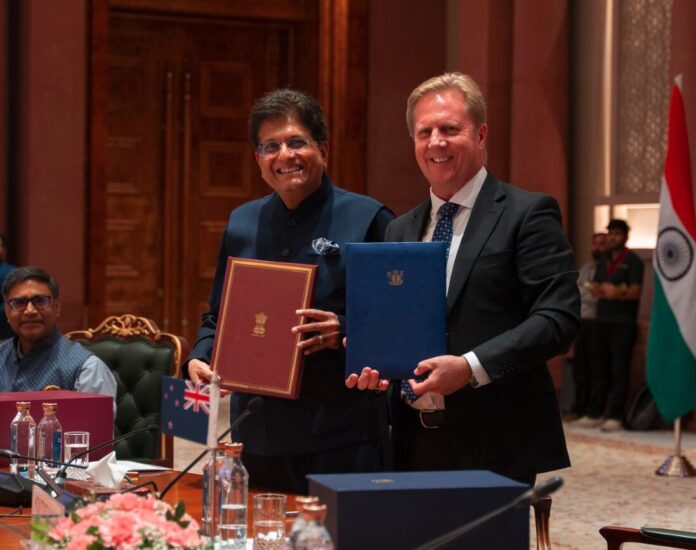
Trade and Investment Minister, Todd McClay and Indian Minister for Commerce and Industry, Piyush Goyal, have signed a once-in-a-generation Free Trade Agreement (FTA) for the two nations.
The Agreement was signed in New Delhi today in front of a large crowd of New Zealand and Indian businesspeople.
“The benefits of this FTA are widespread, and our business community is excited to see the doors of opportunity open to 1.4 billion people whose economy is set to become the third largest in the world,” said Prime Minister Christopher Luxon.
“One in four jobs are tied to trade. In signing this FTA we are setting businesses up to succeed, boosting Kiwi jobs and enabling economic growth – and that means more money in Kiwis’ pockets.”
Mr McClay says the FTA supports New Zealand’s ambitious goal of doubling the value of exports in 10 years.
“This deal will deliver thousands of jobs and billions of dollars in additional exports,” he says.
“Creating opportunities for our businesses to diversify and create strong trading relationships provides economic security for New Zealanders – and that is crucial in these times of global unrest.”
The historic agreement was concluded in December and eliminates or reduces tariffs on 95% of New Zealand’s exports – among the highest of any Indian FTA. Almost 57% of New Zealand’s exports will be duty-free from day one including lamb, wool, coal, leather, most forestry and industrial products. This will increase to 82% when fully implemented including infant formula, a kiwifruit quota almost four times our current exports and seafood. The remaining 13% including kiwifruit, apples, mānuka honey, wine and some dairy is subject to sharp tariff cuts.
The Prime Minister said the signing ensures New Zealand is on track to benefit from a Most Favoured Nation clause for wine and services exports, whereby the better access the European Union has secured for its wine and services will be extended to Kiwi exporters if the new agreement comes into force first.
“That clause will be worth tens of millions of dollars in extra exports for the New Zealand economy,” Mr Luxon says.
“Two-way trade is currently NZ$3.95 billion. The deal we have struck and the relationship we have built will grow this exponentially and deliver deep and lasting benefits for generations to come.”
Signing activates the standard parliamentary process, allowing Parliament and the public to scrutinise the agreement through the Select Committee. The FTA text and National lnterest Analysis will be tabled in Parliament tomorrow and referred to the Foreign Affairs, Defence and Trade Committee (FADTC).
Once FADTC has completed its examination, enabling legislation will be introduced and will follow the usual legislative process. This approach is consistent with that taken for the TPP, CPTPP, and agreements with the United Kingdom, European Union, and United Arab Emirates.
