
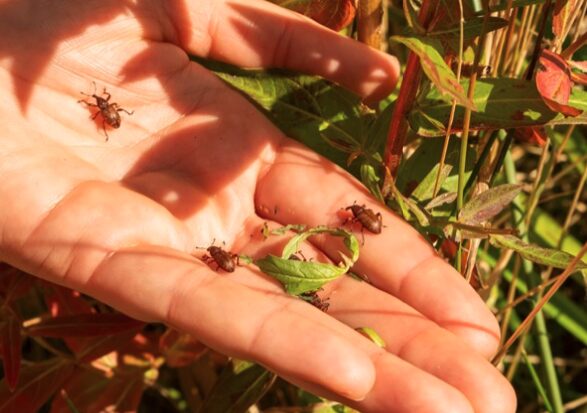
Horizons Regional Council, Bioeconomy Science Institute Maiangi Taiao, Lake Horowhenua Trust and Muaūpoko Tribal Authority have teamed up to release the first biocontrol insect species aimed at reducing the impact of the invasive pest plant, purple loosestrife.
Council pest plant team leader, Michael Beech says purple loosestrife grows predominantly along stream and lake margins, drains, wetlands and even coastal dunes.
“If left to its own devices, it quickly forms dense stands which shade out and displace native biodiversity. It also clogs up waterways which can cause issues with drainage and lead to flooding.”
He says purple loosestrife is a significant issue in the Horowhenua District.
“Purple loosestrife has established in several areas across Horowhenua, especially around the margins of Punahau Lake Horowhenua and in the Hokio Beach area along stream banks.”
“It’s a rather unique problem for our region, as it’s not abundant or at damaging levels throughout other parts of the country yet.
“If left unchecked, however, it has the potential to become a problem across the wider region and beyond.
“This is why we have concentrated our initial releases of the insects in and around these areas, as there’s plenty of space for the bugs to establish.”
Mr Beech says the insects, a weevil and a leaf beetle, work in tandem by attacking different parts of the plant, reducing its overall reproductive capability.
“The weevil attacks and feeds on the root system of the plant, causing it to expend its energy on fighting the insects’ damaging behaviour instead of producing a large healthy plant,” he said.
“The leaf beetle works alongside the weevil, attacking the leaves of the plant. This reduces its ability to absorb light and nutrients, slowing its growth.”
Observation and research from North America was key in understanding the impacts the insects would have on New Zealand’s purple loosestrife problem, says Mr Beech.
“We were very fortunate people in North America had done most of the research for us already, including host range testing* as there are no native loosestrife species in New Zealand.”
“It used to be a big problem for large areas of significant wetland habitat in the United States, but in a 20-year period the insects have been able to significantly reduce the abundance of the plant there.
“Learning from the American experience with the insect’s behaviour, release methods and how they were successfully implemented was vital in understanding how to approach the problem here.
“This information informed our application to the Environmental Protection Authority, who have granted approval to release four different insect species.
“We’ve been able to release two so far, and hope to continue work to release the remaining two species soon.
“It’s been a long but rewarding journey to get here. To see years of hard work culminate in a solution that’s a first for Aotearoa is a proud moment for us.”
The process would also not have been possible without collaboration with several key partners, says Mr Beech.
“We’ve been fortunate to work with Bioeconomy Science Institute Maiangi Taiao over the last five years, who have put countless hours into preparing the insects for release,” he says.
“We’ve also worked closely alongside the Lake Horowhenua trustees and Muaūpoko Tribal Authority throughout the process.
“As holders of the knowledge and history of the lake and its surrounds, Muaūpoko and the lake trustees were imperative to the initial investigation process.
“They also granted us permission to release the insects on their land and even assisted with the release on the day.”
Plans are in place to travel back to North America next year to harvest more of both leaf beetle species, says Mr Beech.
“One of the species we have approval to release has been difficult to mass rear for reasons we are yet to determine.
“We’re hoping to harvest more of them to learn how best to mass rear these insects here so we have the best chance at getting them established.”
*Host range testing refers to the process of testing the biocontrol insects on similar plant species to see how they interact, and if the insect will attack those plants. If it does attack similar plants, it’s unsuitable for use as its not specific enough to the individual plant species. As New Zealand has no native loosestrife species, no other similar plants in adjacent families, and the only other loosestrifes being present in NZ being exotic anyway, there was no requirement to do the testing in NZ.
