
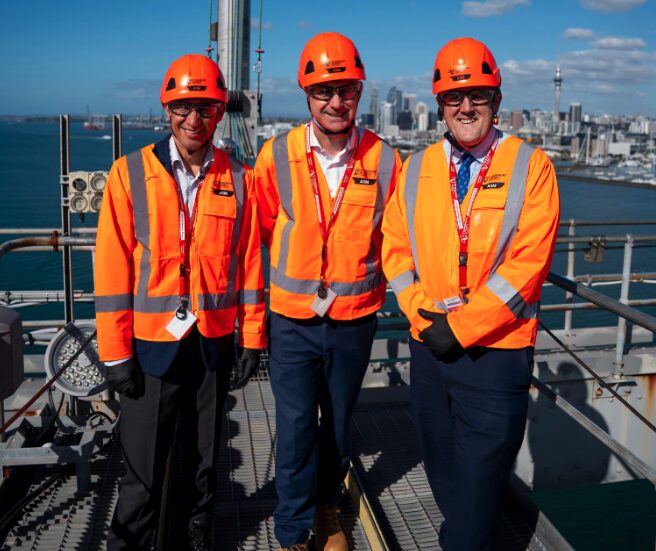
The Government has announced its next steps for the Waitematā Harbour Crossing (WHC) project, which it says is likely to be the largest and most expensive infrastructure project ever undertaken in New Zealand.
In May, the New Zealand Transport Authority (NZTA) completed an Investment Case, with the NZTA Board endorsing a tunnel as the preferred option for the crossing.
“Despite the great progress that has been made, more information and work is required before Cabinet can select a preferred option,” said Transport Minister Chris Bishop.
“Given the scale and complexity of this project, Cabinet has agreed that an independently led DBC is needed. This will allow us to do further work required on funding and financing, and delivery model options. It will also allow us to consider the Auckland transport network more broadly including NZTA’s Auckland Motorway Plan, any time-of-use charging scheme, and the 30-year Auckland Integrated Transport Plan to be developed as part of the Auckland Transport governance reforms.”
The WHC DBC will be independently led by a Senior Responsible Owner (SRO) who will answer directly to the Ministers of Finance, Transport, and Auckland, and Cabinet.
“We will look globally to find the right person for this critical role – someone with the expertise and experience to deliver who we will hold to account,” said Mr Bishop.
“Every country that has built a megaproject this size has learned the same lesson: they cost more and take longer than the first estimates suggest. Not necessarily because of the engineering, but because of scale, duration, and the number of approvals and decision-makers involved along the way. That’s a governance problem, and it has a governance solution.
“The Crown is the decisionmaker, it holds the funding levers, and it carries the risk, so we need to be able to direct the project. NZTA has done good work to get us to this point and will remain central to delivery, but it’s Cabinet’s view that the project should directly report to Ministers.”
The SRO will be supported by a Steering Group comprised of senior representatives from Treasury; NZTA; National Infrastructure Funding and Financing Ltd; the Ministry of Cities, Environment; Regions, and Transport; independent members; as well as the Board Chair of the Auckland Regional Transport Committee.
“It’s important that we work meaningfully with Auckland and Aucklanders,” said Auckland Minister, Simon Watts.
“The Mayor of Auckland has expressed a strong view that a corridor solution at Meola Reef is a better idea than NZTA’s proposals. The Meola Reef option has been looked at many times in the past before and discounted as unachievable, but in the spirit of good faith, and recognising the Government’s responsibilities under the Auckland City Deal, Cabinet has agreed to commission a further study into the option, if the Council is interested.”
The study would be commissioned by the WHC project SRO, independent from NZTA. Auckland Council will be invited to contribute to the study’s scoping and procurement, and to fund 50% of the cost of the study.
“In addition, the Government has also received a Market Led Proposal (MLP) from a reputable international consortium for an innovative construction methodology to upgrade the existing bridge. Officials have recommended that this proposal advance and be integrated as part of the detailed business case phase of work on the WHC project,” Mr Bishop says.
“This is exactly what the MLP process is for. If the private sector has innovative ideas and solutions, we want to consider those. The Government certainly doesn’t have a monopoly on good ideas.
“Previous governments have gone out and announced what they are going to build before they have done the work required around how much it will cost, how they are going to pay for it, and whether the project is deliverable. This Government does not intend to make the same mistake.
“It is also our intention to consult meaningfully with the Opposition and Aucklanders before endorsing an option. This project will span multiple Parliaments and multiple governments – it is important that all serious political parties buy-in to the process.”
Mr Bishop said he expects the next phase of work to be completed in 2027. The Government will then consider the DBC, which will include the Meola Reef study and the market-led proposal, before making decisions on a preferred crossing option.
