
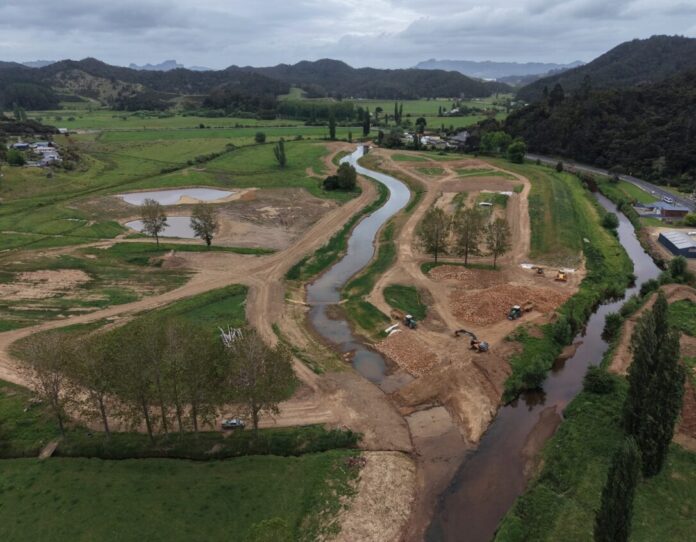
Water is flowing through the new Kāeo River channel for the first time, marking a significant milestone in Northland Regional Council’s Kāeo Flood Resilience Project.
The upstream end of the new channel was opened last week, allowing water to flow for the first time as work continues on Stage 2 of the project.
Council member, Colin ‘Toss’ Kitchen, who chairs the Kāeo-Whangaroa River Working Group, says having water flow through the new channel for the first time is a significant milestone for the project.
“This is a major step forward after a huge amount of work on the ground to get to this point,” Cr Kitchen says.
“The project is about improving the way floodwater moves through this area and helping reduce flood risk for Kāeo township and the adjacent State Highway 10 network.”
The new river alignment shifts the meeting point of Waikare Creek and the Kāeo River about 500 metres downstream. This is intended to reduce the backwater effect from the Kāeo River during heavy rain, helping reduce flood risk for the township and State Highway 10.
The milestone was marked with a short blessing led by local hapū. Project archaeologists also shared information about the age of several of the archaeological features uncovered during the earthworks.
Radiocarbon dating of five fire features placed four features at an age of 1670-1800+ AD and one of 1400-1450 AD. The earlier date is thought to relate to gardening, reinforcing evidence of Māori use of the landscape early in the settlement of Aotearoa.
Archaeological work continues to be actively managed on site, with archaeologists and cultural monitors supervising excavation.
Meanwhile, Cr Kitchen says while getting water flowing through the new channel is an important milestone, work on Stage 2 is not yet finished.
Fish relocation from the section of the old river channel to be infilled has also been undertaken by Ngā Kaitiaki o Ngā Wai Māori, who have whakapapa connections to this rohe and are sharing their knowledge with local hapū, iwi and cultural monitors.
For tangata whenua, ensuring all taonga species are transferred with manaaki is central to this work, including caring for tuna elvers as they return from the Pacific Ocean.
Data collected to date indicates an abundance of fish life, an encouraging sign for the project’s restoration aspirations.
Planned habitat for īnanga, wetlands and bittern offers opportunities to support fish life and wider ecological recovery into the future, demonstrating Te Mana o te Wai in practice.
Councillor Kitchen says the fish relocation is taking part at the same time as sheet piling is being used to divert the full flow of the Kāeo River into the new reach of constructed river.
By mid-November, once the fish salvage is complete within it, a 170m stretch of the old Kāeo River channel will be infilled to allow for completion of the deflection bank that will further protect Kāeo township during a flood.
“There is still work to do – and the programme remains weather-dependent – but bringing the new channel online is a really tangible sign of the progress that’s been made,” Cr Kitchen says.
“We’re grateful to the Kāeo community, mana whenua and everyone involved in the project for their patience and support as this work continues.”
Once construction is complete, surveys of the new channel and deflection bank flood infrastructure will be undertaken. Planting of the new river channel and four wetlands is planned for mid-2027 and will be led by community groups.

