
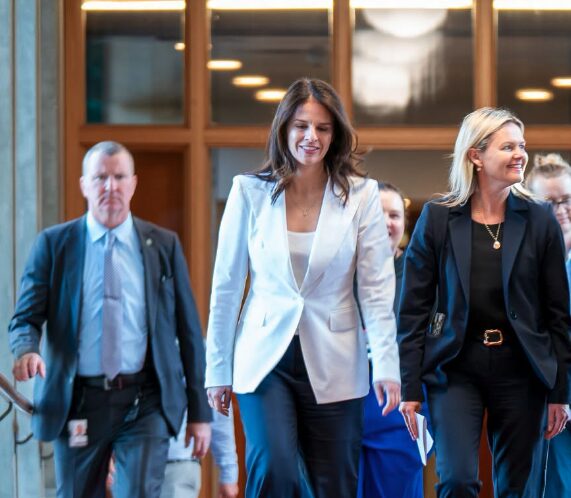
Education Minister, Erica Stanford says the results of the Programme for International Student Assessment (PISA) 2025 indicate New Zealand students remain above the OECD average across reading, science and mathematics, but says more needs to be done to lift performance even further.
Kiwi students ranked ninth in reading, 10th in science, and 16th in mathematics, with the results being broadly similar to PISA 2022.
Positively, New Zealand students were amongst the highest performers in computational problem-solving, which was part of the 2025 PISA focus area, Learning in the Digital World.
Local students were also more positive about school in 2025 than they were in 2022, with more saying they learned useful things and felt prepared for adult life.
“It is encouraging to see students value what they are learning and build the skills they need for a changing world,” Ms Stanford said.
Compared with 2022, PISA 2025 shows:
- The achievement gap between advantaged and disadvantaged students narrowed in all three subjects;
- The number of students who reported applying additional effort when work becomes challenging increased by 6.9%;
- Students placed greater value on school and were more likely to say they are learning useful skills for work and life.
The latest results also showed a significant narrowing of the socio-economic achievement gap, driven by strong gains among students from the most disadvantaged backgrounds, said Ms Stanford.
“For years, a child’s socio-economic background has been far too strong a predictor of how well they will do at school.”
“For the first time in years, that gap is closing, and it is closing because students at the bottom are doing better.”
Between 2022 and 2025, students in the lowest socio-economic quartile made gains equivalent to around a full year of learning in science, three terms in maths and six months in reading.
“In science and maths, achievement among the most advantaged students was essentially unchanged. This is not a story of the top coming down. It is a story of the bottom coming up,” said the Minister.
“Importantly, the Ministry has tested these results against the known participation issues with the PISA sample, and the narrowing of the equity gap remains statistically significant.
“We still have a long way to go, and our overall results remain well below where New Zealand was 15 years ago. But after years of decline, this is an encouraging change in direction.”
Ms Stanford says improved attendance is likely to be part of the picture.
“You cannot learn if you are not at school. Regular attendance in Term 2 has risen from 39.6% in 2022 to 64.3% in 2026.
“I want to acknowledge teachers, school leaders and everyone across the education sector who have worked incredibly hard to improve outcomes for our kids.”
She says Government reforms are focused on accelerating that progress, including structured literacy and maths, an hour a day of reading, writing and maths, a clear knowledge-rich curriculum, better resources and earlier intervention for students who fall behind.
“My focus is on closing the equity gap. A child’s means should never determine their destiny.”
“Where you live, what school you attend or what your parents earn should not determine how far you can go. Every child deserves access to an excellent education, and that is what we are determined to deliver.”
While the Minister says the latest PISA results are encouraging, some caution should be applied when interpreting the data.
“New Zealand did not meet the OECD participation requirements for PISA 2025. Only 52% of selected schools and 76% of selected students took part. This means the results may look more positive than they would in a fully representative sample and need to be treated with care,” she outlined.
“PISA and other similar longitudinal international studies provide valuable insights into how our education system is performing and changing over time.”
Ms Stanford said taking part in international studies is essential.
“Together with our national data, these studies help us understand the strengths of our education system and where we need to improve.”
“This is why the Government recently passed legislation that requires selected schools to participate in PISA and other international monitoring tools.
“Greater use of data to drive consistent improvement is one of my six education priorities. We are focused on using data from studies such as PISA to make decisions to raise student achievement.”
NZ PISA results at a glance:
| PISA Science | 2000 | 2003 | 2006 | 2009 | 2012 | 2015 | 2018 | 2022 | 2025 |
| New Zealand | – | – | 530 | 532 | 516 | 513 | 508 | 504 | 509 |
| OECD Mean | – | – | 495 | 498 | 498 | 491 | 489 | 485 | 482 |
| PISA Reading | 2000 | 2003 | 2006 | 2009 | 2012 | 2015 | 2018 | 2022 | 2025 |
| New Zealand | 529 | 522 | 521 | 521 | 512 | 509 | 506 | 501 | 497 |
| OECD Mean | 494 | 494 | 485 | 491 | 493 | 490 | 487 | 476 | 461 |
| PISA Maths | 2003 | 2006 | 2009 | 2012 | 2015 | 2018 | 2022 | 2025 | ||
| New Zealand | – | 523 | 522 | 519 | 500 | 495 | 494 | 479 | 480 | |
| OECD Mean | – | 499 | 490 | 492 | 490 | 487 | 489 | 472 | 463 | |
