
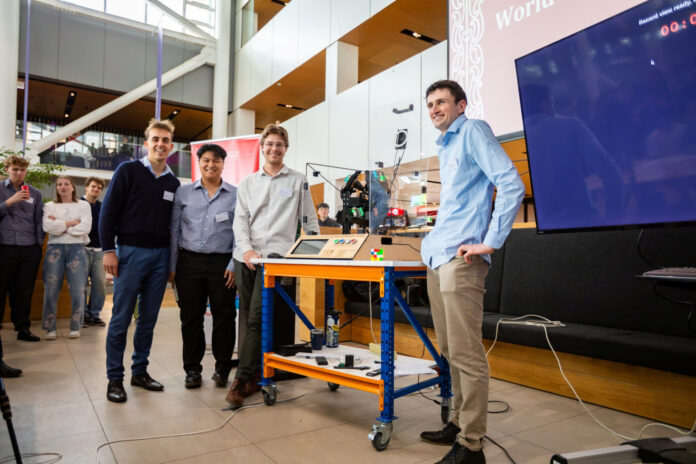
Four University of Canterbury (UC) engineering students have built a robot capable of solving a 4×4 Rubik’s Cube in under 10 seconds, and are now setting their sights on a world record and a time faster than any human has achieved.
Fourth-year Mechatronics Engineering students Caleb Everitt, Hayden Watson, Maz Cameron and Johann Torres turned their final year project into a mission to beat both the robotic and human Guinness World Records for solving a 4×4 Rubik’s Cube.
The students made their official Guinness World Record attempt on Friday 16 October, recording a time of 9.806 seconds. They are now awaiting confirmation from Guinness World Records.
The idea was sparked by a video on social media showing the existing world record-holding robot solving a 4×4 Rubik’s Cube in 45 seconds. Noticing that the robot was significantly slower than the human world record of 15 seconds, the students saw an opportunity to push the technology further and set out to build something faster.
“We knew that robots could be better than humans, and we wanted to be the people to break that gap,” Cameron says.
“The 4×4 Rubik’s Cube is more complex [than the 3×3], and I think that combination of complexity and a low budget to attempt breaking the record was what excited us.”
The four students divided the project into four key areas: mechanical design (Caleb Everitt), electrical and motor control (Johann Torres), computer vision (Hayden Watson), and software development (Maz Cameron). Each took responsibility for a different aspect of the robot, from designing and building its physical structure and developing the camera system to programming the motors and integrating the software needed to solve the cube.
“The robot has four cameras; it looks at the cube, and sees where all the different colours are,” Watson says.
“This information is then fed into an open-source algorithm that works out the moves needed to solve it.”
The students’ robot combines faster motors with an innovative design that allows it to solve the cube more efficiently than the current record holder.
“The previous robot can only do face rotations in two out of the three cube axes, so it has to reorientate the cube, which essentially wastes a move. Whereas we don’t do that because we can access all three faces,” Everitt says.
As part of their self-proposed capstone project, the team faced several engineering challenges, including developing a camera system that could accurately distinguish between similar colours under different lighting conditions and ensuring the cube wouldn’t jam during high-speed movements.
They refined the software, improved the robot’s structural rigidity and introduced suction cups to move the cube more quickly and precisely, overcoming these challenges through extensive testing and problem-solving.
“One of the reasons that we needed suction cups was because to beat the human record, the time it takes for the cube to drop down from being pushed back to the base position is too slow if we just use gravity,” Everitt says.
Working within a very limited budget funded by UC’s Mechanical Engineering Department, the students opted for high-speed motors commonly used in drones, paired with specialised controllers that deliver the precision, power and speed needed to solve the cube in record time.
“We didn’t realise how good the motors were until we started playing around with them and suddenly it’s just going really, really quickly,” Torres says.
“I remember seeing it for the first time. I was like, ‘wow, this is insane. It’s actually possible that we’re going to beat the record.’”
Cameron says they’ve worked well together as a team.
“Our skills balance each other nicely and everyone is willing to put in the extra hours. And I think that those extra hours is what’s gotten us down below that human record time, just coming up with those creative solutions.”
For the students, the project marks the culmination of four years of study and the opportunity to put their engineering skills to the ultimate test.
“You have all these things coming together right at the end of your degree. And it’s the kind of the proof that you are actually an engineer now,” Everitt says.
With their final year of study coming to an end, all four students have already secured graduate roles for next year, taking up engineering positions across New Zealand.
The robot will remain at UC, and the team hopes it will inspire the next generation of engineers, showing young people what’s possible when creativity, innovation and engineering come together.
