

SPONSORED CONTENT
Āpōpō – Infrastructure Asset Management Professionals
New Zealand’s infrastructure challenges are increasingly visible, exposing systemic weaknesses that have contributed to declining asset condition and performance over time.
Across water, transport, health, education, defence, justice, and other infrastructure types, poor asset condition is constraining service delivery, undermining resilience, and inhibiting economic performance. Over the past year, major national reviews, including work by Te Waihanga (New Zealand Infrastructure Commission), Infrastructure New Zealand in partnership with Beca, and the Helen Clark Foundation with WSP, have converged on a shared conclusion: lifting asset management performance is essential to closing the infrastructure gap and delivering value for future generations.
These reviews, alongside relevant Cabinet-endorsed initiatives, contain more than 50 individual recommendations aimed at strengthening New Zealand’s infrastructure system. Their collective breadth reflects the scale and complexity of the challenge, making prioritisation difficult. This report aims to address that by identifying where effort is most likely to yield effective improvement.
Āpōpō worked with senior asset management professionals from across central government, local government, utilities, and advisory organisations to identify and rank the ten actions most critical to lifting asset management performance. The result is a focused, practitioner led agenda that distils existing evidence into a practical set of priorities, grounded in frontline experience.
The message from the sector is clear. Real progress will not come from isolated funding increases or single policy reforms. Progress depends first on setting the right system conditions — specifically strong governance, disciplined longterm planning, and a renewed commitment to stewardship, all supported by specific capability investment in the people responsible for the asset management function. These factors shape whether infrastructure assets are managed proactively over their full life cycles or allowed to deteriorate through incremental maintenance deferral and reactive decision making.
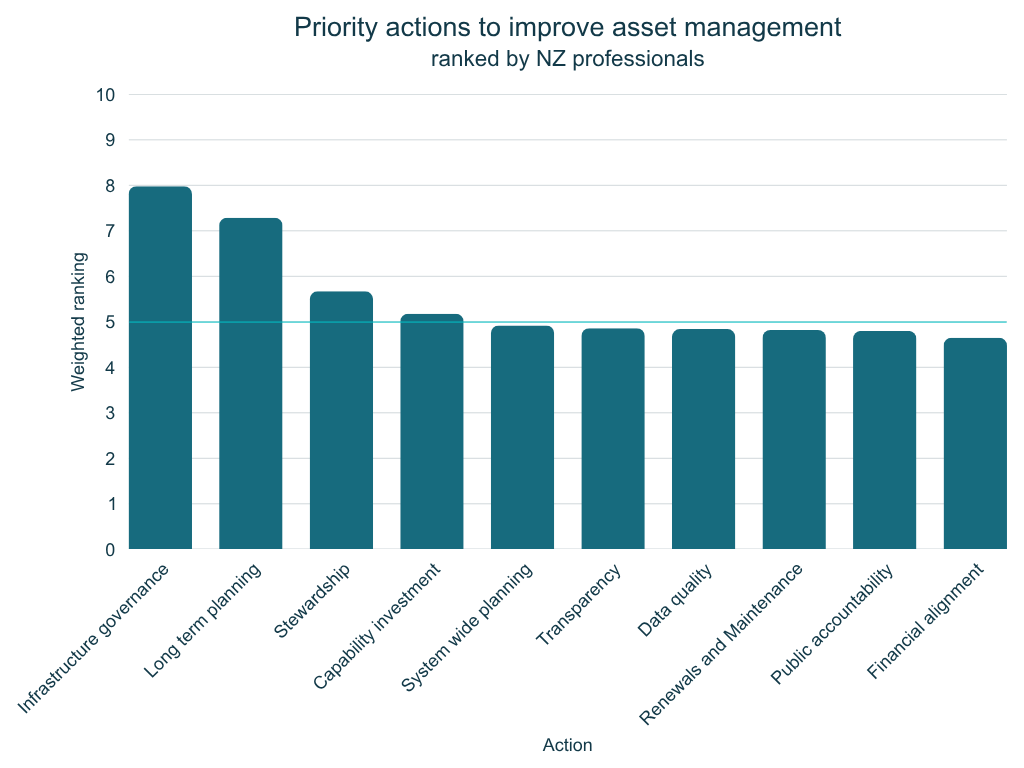
Of the ten priorities identified, infrastructure governance ranked highest by a clear margin. Asset management must be treated as a core leadership responsibility rather than a technical support function. This requires explicit executive-level accountability for stewardship outcomes and routine visibility of asset condition, risk performance and long-term cost, alongside financial results and service delivery measures.
Longterm planning ranked second, reflecting concern that too many assets have been delivered without credible plans for operation, maintenance, renewal, or affordability. Short planning horizons and fragmented investment decisions make it harder to manage cumulative risk, prioritise renewal, and maintain intergenerational fairness.
Stewardship ranked third, highlighting the need to embed intergenerational thinking and responsibility into decision making. Weak stewardship settings make asset management vulnerable to short term pressures, leading to deferred maintenance and reactive responses to failure. Strong stewardship reframes infrastructure as taonga held in trust, shifting the question from what can be deferred to what must be sustained.
Capability investment also stood out as important. Enabling more people (capacity) with responsibility for looking after our infrastructure to develop their expertise and experience (competency) and to access the tools and knowledge resources that support the effectiveness of their work, provides a strong pathway for improved performance.
The remaining priorities – systemwide planning, transparency, data quality, prioritising renewals and maintenance, public accountability, and financial alignment, largely ranked of equal importance, reinforce and enable the first four foundational shifts. Together, they support more confident decision making, better alignment between plans and funding, and improved public trust.
These rankings tell a story that points to a common element: change needs to come from the top down. New Zealand has skilled and competent asset management professionals, but their effectiveness is often limited by weak leadership signals, fragmented accountability, limited capacity, and systems that prioritise short term decisions over longterm outcomes. Strengthening governance and planning settings is a prerequisite for building professional capability, improving data and information, and lifting performance across the system.
There are early signs of progress. The Government’s recent strengthening of assurance for central government funded infrastructure responds directly to longstanding concerns about fragmented assurance, weak or absent asset management plans, and limited ability for Ministers to make confident early decisions. These changes reinforce the direction practitioners are calling for and create an opportunity to lift standards consistently across central government, aligning more closely with expectations already placed on local government as asset owners.
The purpose of this report is to help narrow the focus of New Zealand’s infrastructure conversation. The causes of current challenges are well documented; the imperative now is to translate that evidence into sustained, system level improvement. By identifying a clear set of practitioner endorsed priorities, this agenda provides a durable basis for aligning policy, funding, assurance, and leadership attention.
If New Zealand is serious about improving infrastructure outcomes, and honouring its responsibility to future generations, improving asset management practice remains one of the highest value actions available. This report sets out where to focus first.
Read the report here.

