
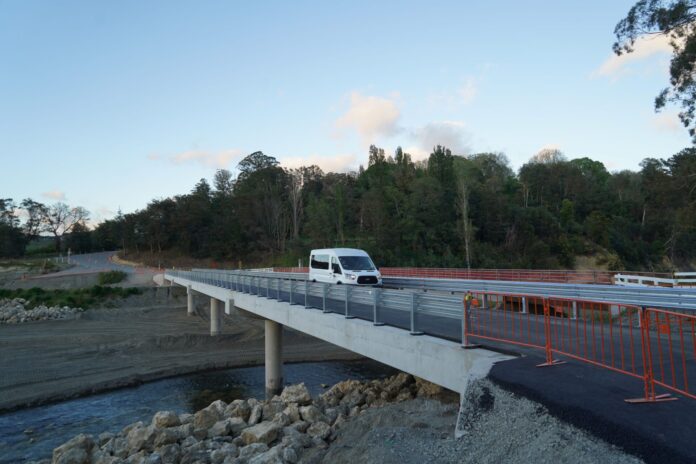
The Hastings District’s new Mangaone-Dartmoor Bridge is now open to traffic, with a formal opening planned for December after final construction works, including removing the temporary crossing, are completed.
After the old bridge was destroyed in Cyclone Gabrielle, a bailey bridge was installed to serve the community ahead of a new crossing being built.
Hastings District Mayor, Wendy Schollum said it was fantastic to see another permanent bridge back in place after the cyclone.
“For the people who use this road regularly, having a permanent bridge restored is a big deal. It’s been a long wait, and I want to thank the local community for their patience while the work has been carried out,” said the Mayor.
“We’ve still got work to do across our cyclone-damaged roading network, but it’s encouraging to see these major projects being completed. We’re focused on restoring connections and building a safer, more resilient network, while making every dollar count.
“Thank you to the project team for their hard work delivering this bridge on time, with the final cost expected to be under budget.”
The new single-lane bridge is 104 metres long and 5.84 metres wide, compared with the original bridge, which was 88.5 metres long and 3.23 metres wide.
Council director of infrastructure delivery, Darren de Klerk said that while the bridge was single-lane due to low traffic volumes, it had improved approach angles and safer turning movements.
“Originally a seven-span structure it’s now four 26-metre spans, which improves flood resilience by freeing up the waterway and reducing potential for debris loading,” Mr de Klerk said.
“The bridge has also been built to withstand more extreme events. The deck sits above 1-in-500-year flood levels, and the structure is engineered to withstand a 1-in-500-year earthquake.”
The bridge takes its name from the Mangaone River, which flows through the Dartmoor valley before joining the Tūtaekurī River.
The completed project cost is expected to be under $15 million, versus an approved budget of $22.5million. The work was fully funded through the National Infrastructure Funding and Financing (NIFF) programme.
